Leasing vs. Buying a Car: How the 3-Year Math Really Works
A lease pays for depreciation plus a rent charge; a loan pays for the whole car. Here is how money factor and residual work, with a 3-year cost example.
Key Takeaways
- A lease payment covers the car’s expected loss in value plus a rent charge, while a loan payment covers the whole price, so the lease payment is usually lower, according to the FTC and the Federal Reserve.
- A money factor converts to an approximate annual rate when multiplied by 2,400, per the Oregon Department of Justice, so a 0.00314 money factor is close to the 7.54% average 60-month new-car loan rate at banks in August 2026.
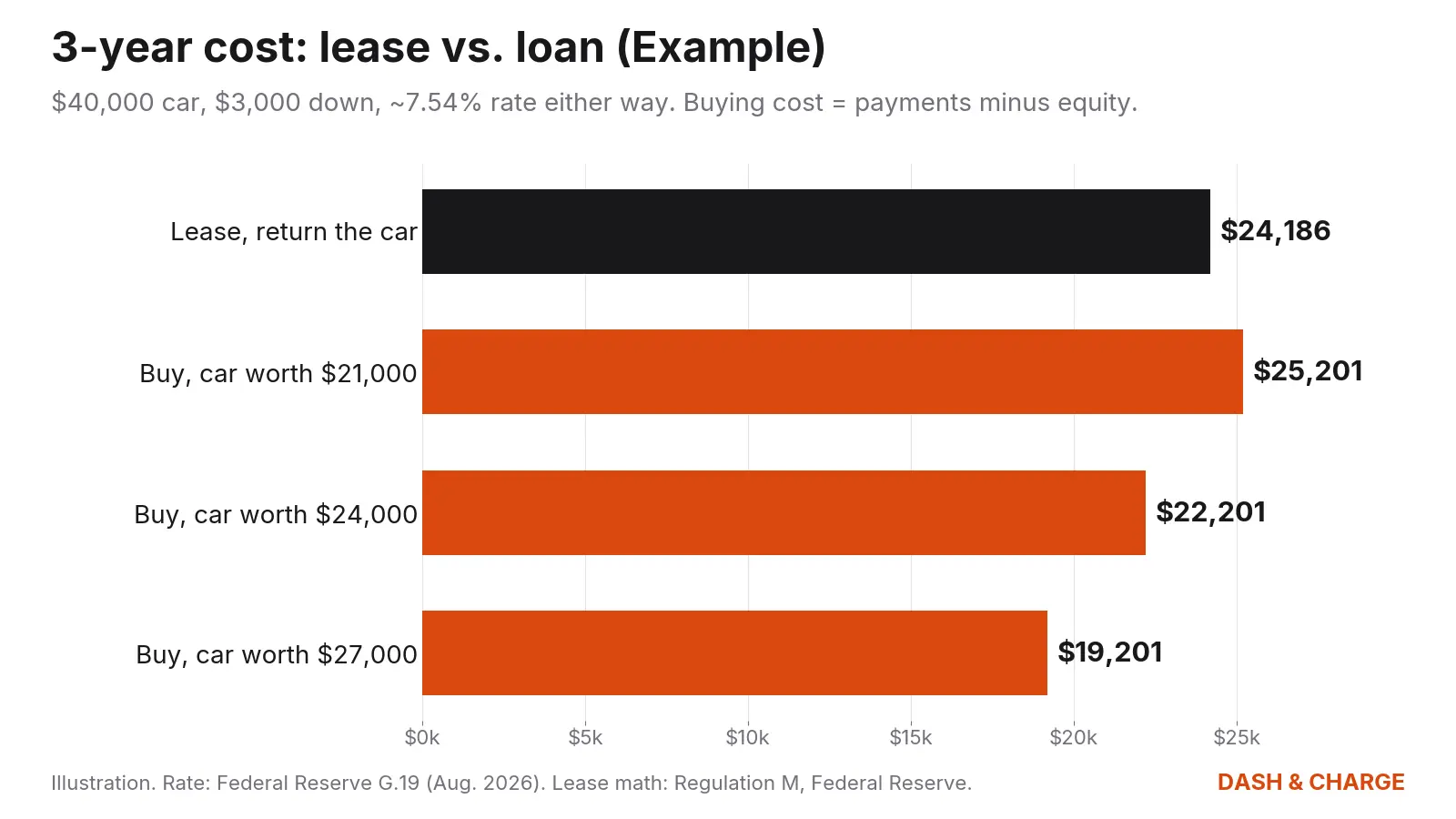
- In our example on a $40,000 car, a 3-year lease costs $24,186, and buying costs $22,201 if the car is worth its $24,000 residual value; buying turns more expensive only if the car is worth less than about $22,015.
In this article
Leasing usually means a lower monthly payment, while buying can cost less over the long run once you count the car you keep, the Maine Attorney General notes. With a lease you pay for the car’s expected loss in value plus a rent charge, then hand it back. With a loan you pay for the whole car and own what is left, as the Federal Trade Commission and the Federal Reserve explain.
In the example below, on a $40,000 car over three years, the lease costs $24,186 and buying costs $22,201, as long as the car is still worth its projected value.
The short verdict
- Leasing fits better if you drive under the mileage limit, want a lower payment, and like switching cars every few years while they are under the factory warranty.
- Buying fits better if you drive a lot, keep cars past the loan term, or might need to get out of the deal early.
- Either can win on cost. The deciding number is what the car is actually worth when the lease would end.
| Lease | Loan | |
|---|---|---|
| What the payment covers | Depreciation, rent charge, taxes, fees | Full price plus interest |
| Monthly payment (example) | $577.39 | $742.11 |
| Mileage | Limit, usually 15,000 a year or less (FTC) | No limit |
| Wear and damage | Charged if beyond the lessor’s standards | No end-of-lease charge |
| Ending early | “Substantial” charge (Regulation M notice) | Pay off the loan; lender holds a lien until then |
| Who bears resale risk | Lessor | You |
How a lease works
Regulation M, the federal consumer leasing rule (12 CFR Part 1013), requires lessors to spell out the numbers in a car lease. In 2026 it covers personal-use leases longer than four months with a total contractual obligation of up to $73,400. These are the terms to find on the disclosure:
- Gross capitalized cost: the agreed value of the car plus anything else paid over the lease, such as service contracts or an old loan balance. Negotiate this like a purchase price, the Maine Attorney General advises.
- Capitalized cost reduction: the down payment, trade-in credit or rebate. Subtracting it gives the adjusted capitalized cost.
- Residual value: the car’s projected value at lease end, set at signing. A higher residual means lower payments.
- Depreciation: adjusted capitalized cost minus residual. In the example below, it is the biggest piece of the payment.
- Rent charge: the part of the payment that is like interest. The Federal Reserve explains that it is usually figured as the money factor times the sum of the adjusted capitalized cost and the residual value.
The money factor is a small decimal, and the Federal Reserve says it typically is not disclosed to you. Multiply it by 2,400 to get an approximate annual rate, the Oregon Department of Justice says. Federal law does not require a lessor to disclose a lease rate, according to the Federal Reserve. If a lessor shows one as a percentage, Regulation M bars calling it an “annual percentage rate” or “annual lease rate” and requires a notice that “this percentage may not measure the overall cost of financing this lease.” The Maine Attorney General notes that you can still ask the dealer to state it as an APR.
Two charges come at the end. If the lessor sets wear-and-use standards, the lease must state the amount or method for any excess-mileage charge and include a notice like this one: “You may be charged for excessive wear based on our standards for normal use.” Ending early carries its own warning: the charge “may be up to several thousand dollars.”
A 3-year cost example: lease vs. loan
Illustration. Assumptions: a $40,000 negotiated price, $3,000 down either way, and sales tax, registration and insurance left out because they vary by state. For a fair test, both deals use the same rate: 7.54%, the average 60-month new-car loan rate at commercial banks in August 2026, according to the Federal Reserve. The lease has an $800 acquisition fee (the Maine Attorney General says these run from $400 to more than $1,200), an assumed $400 disposition fee and a 60% residual.
Lease, 36 months:
- Gross capitalized cost: $40,000 + $800 = $40,800. Minus $3,000 down = $37,800 adjusted.
- Depreciation: $37,800 − $24,000 residual = $13,800, or $383.33 a month.
- Rent charge: money factor 0.00314 (× 2,400 ≈ 7.54%) × ($37,800 + $24,000) = $194.05 a month.
- Payment: $577.39. Over 36 months: $20,786.
- Total: $3,000 + $20,786 + $400 = $24,186, and you return the car.
Loan, 60 months:
- Borrow $37,000 at 7.54%: $742.11 a month, about $26,716 over 36 months.
- Balance still owed after 36 months: $16,485.
- If the car is worth $24,000 (the same as the residual), your equity is $24,000 − $16,485 = $7,515.
- Net 3-year cost: $3,000 + $26,716 − $7,515 = $22,201.
Buying comes out $1,985 cheaper here. That gap is $1,200 in lease fees plus $785 more in rent charge than in loan interest ($6,986 vs. $6,201), because the rent charge is figured on the residual too.
The answer flips if the car loses more value. Buying costs more than the lease if the car is worth less than about $22,015 after three years. At $21,000, buying costs $25,201. That is the risk the Federal Reserve says the lessor carries in a lease: in a closed-end lease, the residual value is set at signing.
Mileage moves the math, too. Say your lease allows 15,000 miles a year and you drive 16,000. That is 3,000 extra miles, and at an assumed 25 cents a mile you would owe $750. The Maine Attorney General says excess-mileage fees usually run 15 to 30 cents a mile.
When leasing fits
The FTC says lease payments are usually lower than loan payments on the same car. Here, the lease saves $164.72 a month. The Maine Attorney General notes that a leased car usually stays under the manufacturer’s warranty, and Oregon’s Department of Justice says most new vehicles come with at least a 3-year/36,000-mile bumper-to-bumper warranty. Leasing suits drivers who stay under the mileage limit, keep the car in good shape and want a new car every few years.
When buying fits
Buying suits high-mileage drivers, people who keep cars for many years and anyone whose plans may change. Oregon’s Department of Justice suggests considering a purchase instead of a lease longer than 36 months, because major repairs tend to show up in the fourth or fifth year. Once the loan is paid off, the payments stop, while a lessee needs a new car or a new lease. Keeping the loan short limits interest; see how loan length changes the cost and how auto loan rates are set.
How to decide
Get one negotiated price, then ask for both a lease quote and a loan quote on that price. On the lease, ask for the adjusted capitalized cost, residual value, money factor, mileage limit, per-mile charge and the acquisition and disposition fees. Multiply the money factor by 2,400 and compare it with your loan APR. Then run the example above with your numbers and a realistic guess of the car’s value in three years. If you lease, check whether GAP coverage is already included before you pay for it separately.
Sources
- Consumer Financial Protection Bureau — 12 CFR Part 1013, Consumer Leasing (Regulation M)
- Consumer Financial Protection Bureau — § 1013.4 Content of disclosures (Regulation M)
- Consumer Financial Protection Bureau — § 1013.2 Definitions (Regulation M)
- Federal Trade Commission — Financing or Leasing a Car
- Federal Reserve — Vehicle Leasing: More Information about the Rent Charge
- Federal Reserve — Vehicle Leasing: Leasing vs. Buying: Monthly Payments
- Federal Reserve — Vehicle Leasing: Leasing vs. Buying: Rate Disclosure
- Federal Reserve — Vehicle Leasing: Leasing vs. Buying: Future Value
- Federal Reserve — G.19 Consumer Credit (released Oct. 7, 2026)
- Oregon Department of Justice — Leasing a Vehicle
- Maine Attorney General — Leasing a New Vehicle