Car Insurance Prices Fell 5% Over the Past Year, BLS Data Shows
Car insurance prices fell 5.0% in the year to September 2026, per the BLS, after a 22.6% yearly rise at the 2024 peak. Why, and what it means at renewal.
Key Takeaways
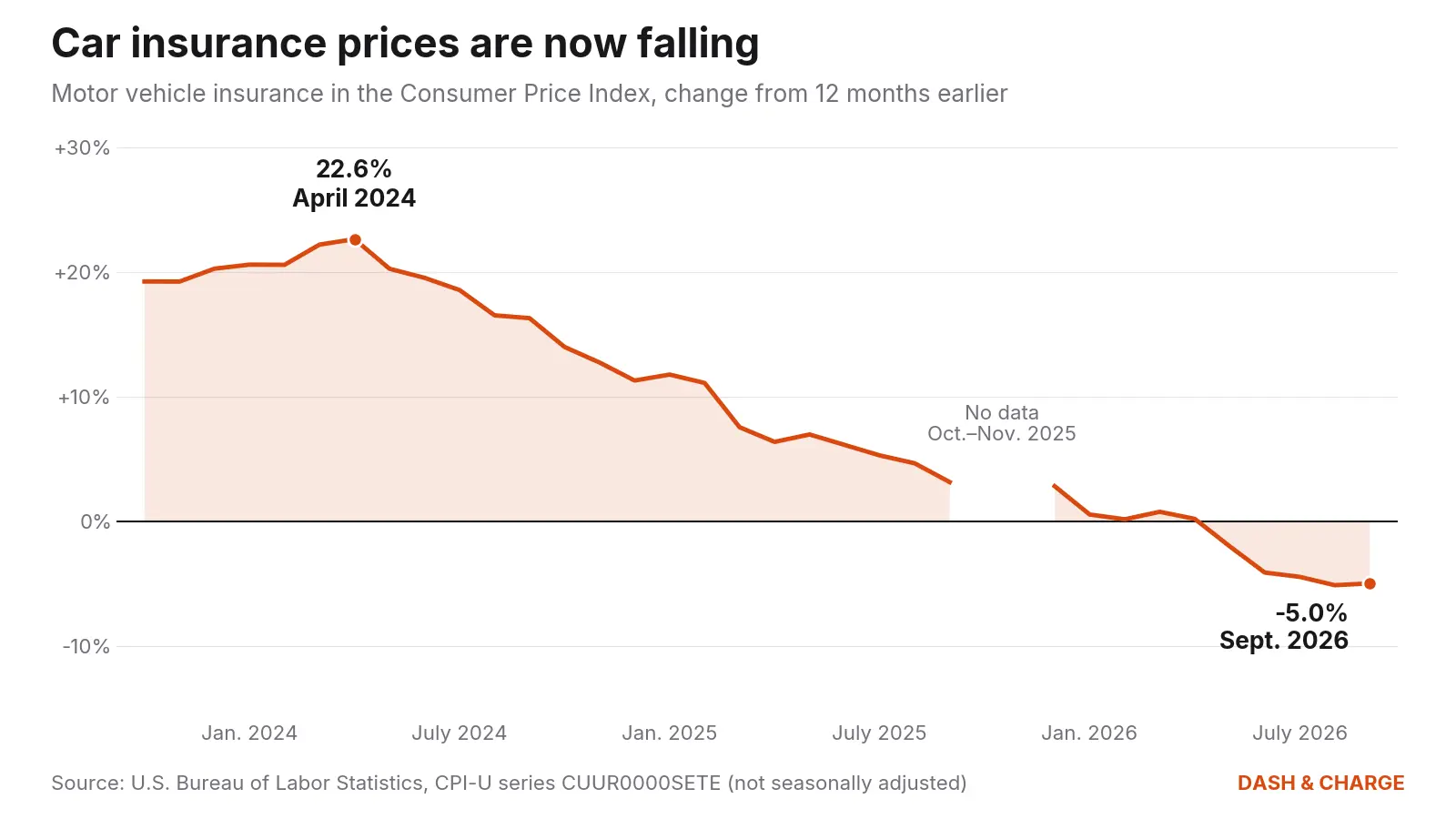
- The motor vehicle insurance index in the Consumer Price Index fell 5.0% in the 12 months to September 2026, according to the Bureau of Labor Statistics.
- The yearly change has been negative every month since May 2026, after insurance prices rose more than 10% a year from September 2022 through February 2025.
- Even after the decline, the BLS insurance index in September 2026 was 49.4% higher than in September 2021.
In this article
Car insurance prices fell 5.0% in the 12 months to September 2026, according to the Bureau of Labor Statistics (BLS). It is a sharp turn from early 2024, when the same measure was rising more than 20% a year.
The figure comes from the motor vehicle insurance index in the Consumer Price Index (CPI), the government’s main inflation gauge. It tracks the average change in car insurance prices paid by urban consumers nationwide, not any one company’s rates.
The latest numbers
In September alone, the insurance index rose 0.1% on a seasonally adjusted basis, meaning after the BLS removes normal seasonal swings. That small uptick followed declines of 0.3% in July and 0.8% in August. Before seasonal adjustment, the index fell 0.3% from August to September.
The decline stands out against the rest of the car budget. Over the same 12 months, overall consumer prices rose 3.7%, and the index for motor vehicle maintenance and repair rose 5.8%, according to the BLS.
From 20% increases to a 5% decline
The insurance index rose by double digits, compared with a year earlier, every month from September 2022 through February 2025, based on BLS index levels before seasonal adjustment. The yearly increase peaked at 22.6% in April 2024. It then slowed through 2025, turned negative in May 2026 and has stayed below zero since.
| Month | 12-month change in BLS car insurance index |
|---|---|
| September 2022 | +10.3% |
| September 2023 | +18.9% |
| April 2024 (peak) | +22.6% |
| September 2024 | +16.3% |
| September 2025 | +3.1% |
| May 2026 | −2.0% |
| September 2026 | −5.0% |
Not seasonally adjusted. Changes for months other than September 2026 are calculated by Dash & Charge from BLS index levels. The BLS series has no October 2025 value (the BLS says the data are unavailable because of the 2025 lapse in appropriations) and no November 2025 value, so yearly changes for those two months cannot be calculated.
The biggest monthly drops came in May and June. On a seasonally adjusted basis, the index fell 1.7% in May 2026 and 2.0% in June 2026, based on BLS index levels. Before seasonal adjustment, the index was at its highest published level in February 2026; by September it was 5.7% lower.
Why prices turned around
Insurers set prices based on what they expect future claims to cost, according to the National Association of Insurance Commissioners (NAIC), the group of state insurance regulators. When claim costs rose after the pandemic, so did premiums. Now some of those costs have eased.
The Insurance Information Institute (Triple-I), an insurance industry group, said in June 2026 that personal auto insurers posted their strongest underwriting results of the post-pandemic era in 2025. Their combined ratio, which compares claims and expenses with premiums, improved to 91.8 from 95.3 in 2024. Triple-I says a ratio over 100 means insurers are paying out more than they take in.
| Year | Personal auto net premium growth (Triple-I) | Personal auto combined ratio (Triple-I) |
|---|---|---|
| 2023 | +14.4% | — |
| 2024 | +12.8% | 95.3 |
| 2025 | +4.0% | 91.8 |
— = not given in the Triple-I sources used here.
Triple-I tied the cooling to lower vehicle replacement and repair costs. It said CPI measures for used cars, new vehicles and auto parts declined from 2023 to 2024, for the first time since 2019, and that insurer rate changes have historically followed vehicle prices with a slight lag. It also said the cost of physical damage claims (repairs to the car itself) fell below its 2022 level by 2025, helped by fewer claims overall.
Not every cost has eased. Triple-I said the average cost per liability claim, which covers injuries and legal costs, rose 67.5 points between 2019 and 2025. In Triple-I’s view, what it calls “legal system abuse,” including aggressive litigation, attorney involvement and exceptionally large jury payouts, continues to be a major cost driver, especially for auto liability. Triple-I credits Florida’s legal reforms, begun in 2022 and 2023, with lower auto rates there. In an April 2026 brief, it said the five largest auto insurers in Florida made average rate cuts of more than 6% through mid-2025, and that 42 personal auto insurers had filed for rate decreases over the prior year.
What it means for you at renewal
The national index falling does not mean your own bill will fall. The NAIC lists what drives an individual premium: your driving record, claims history, where you live and garage the car, your age or years of driving experience, gender and marital status, the car you drive and its repair cost, your coverage limits and deductibles, annual mileage, your insurance score and driving habits collected by telematics. A ticket or a claim can outweigh a national trend. For more, see how car insurance premiums are calculated.
Example: a renewal that tracks the national index. Say a policy cost $1,000 in September 2021 and moved exactly with the BLS index (566.211 in September 2021).
- September 2025: $1,000 × (890.473 ÷ 566.211) = about $1,573.
- September 2026: $1,000 × (846.102 ÷ 566.211) = about $1,494.
The renewal would be about $78 cheaper than a year ago ($78.36 before rounding the two prices), a 5.0% cut. But it would still be about $494, or 49.4%, more than in 2021. The decline gives back only a small part of the earlier increases.
Example: checking your own renewal. If you paid $2,000 a year ago, a renewal in line with the national change would be about $1,900 ($2,000 × 0.95). If your quote is flat or higher, it is worth asking your insurer what changed in your rating factors.
The NAIC suggests getting quotes from several companies and making sure “you’re comparing like policies,” with the same coverages. It also lists asking about discounts, bundling auto with home or renters coverage, and raising your deductible if you can afford it out of pocket. On an older car with little value, the NAIC says to consider dropping comprehensive or collision coverage. Our guides to ways to lower car insurance and liability vs. collision vs. comprehensive go through those options.
What to watch next
- Nov. 10, 2026: the BLS releases the October CPI, the next reading on the motor vehicle insurance index. Because the series has no October 2025 value, a 12-month change for October cannot be calculated from index levels.
- Dec. 10, 2026: the BLS releases the November CPI. With no November 2025 value in the series, a 12-month change for November cannot be calculated from index levels either.
Sources
- Bureau of Labor Statistics — CPI Table 2, by detailed expenditure category, September 2026
- Bureau of Labor Statistics — Consumer Price Index Summary, September 2026
- Bureau of Labor Statistics — CPI-U, Motor vehicle insurance in U.S. city average, series CUUR0000SETE (not seasonally adjusted)
- Bureau of Labor Statistics — CPI-U, Motor vehicle insurance in U.S. city average, series CUSR0000SETE (seasonally adjusted)
- Bureau of Labor Statistics — Schedule of releases for the Consumer Price Index
- Triple-I — Personal Auto Insurance Rebounds After Years of Pandemic Volatility (June 26, 2026)
- Triple-I — Triple-I/Milliman: US P/C Insurance Industry Navigates Recovery Following Years of Elevated Claims Costs and Economic Disruption (May 15, 2026)
- Triple-I — Florida Premiums Drop Amid Post-Reform Stability, New Triple-I Insurance Brief Shows (April 1, 2026)
- NAIC — Why Are My Insurance Premiums Increasing?