GAP Insurance Explained: What It Covers and How It Works
GAP is meant to cover what you owe on a car loan beyond the insurance payout for a totaled or stolen car. How negative equity creates that gap, and refunds.
Key Takeaways
- GAP is an optional product meant to cover the difference between what you owe on an auto loan and what your insurer pays if the car is stolen or totaled, and in most situations a lender or dealer cannot require it, according to the CFPB.
- Between 2018 and 2022, 11.6% of auto loans in a CFPB dataset rolled negative equity from an old car into the new loan, with a mean of $5,073 on new-vehicle loans.
- In Texas, a state rule for GAP waivers sold by regulated lenders requires a full refund if you cancel within 60 days and a pro rata refund if the loan is paid off early.
In this article
GAP, short for Guaranteed Asset Protection, is an optional product meant to cover the difference between what you owe on your auto loan and what your insurance company pays if the car is stolen or totaled. Standard auto insurance pays only up to the car’s value, the Consumer Financial Protection Bureau explains, so if you owe more than that, GAP is supposed to cover the rest.
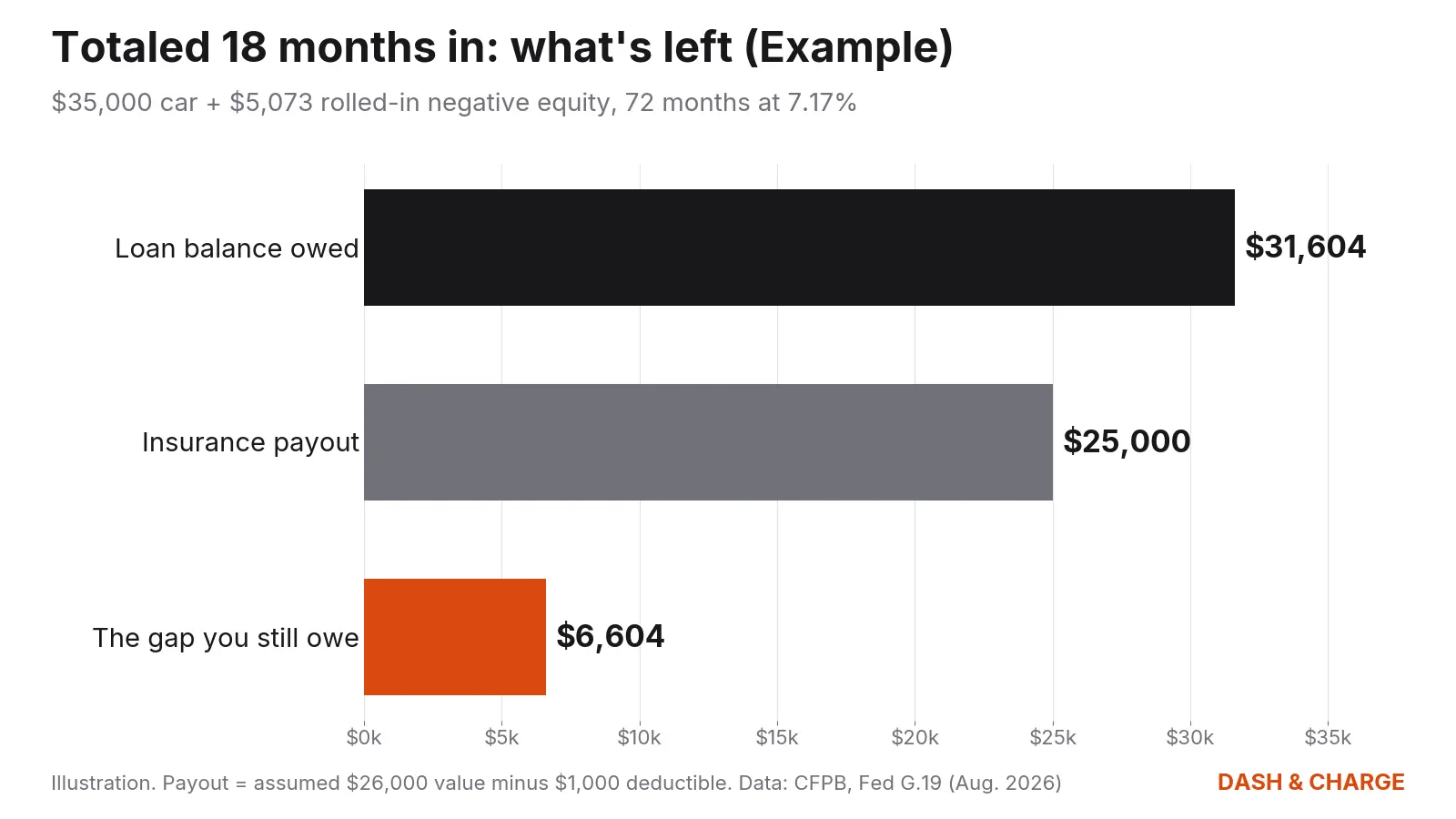
In the example below, a driver whose car is totaled 18 months into a 72-month loan still owes $6,604 after the insurance check.
How GAP works
When a car is totaled, insurers pay only up to its actual cash value, the replacement cost minus depreciation, and they deduct your deductible from collision and comprehensive claims, the Texas Department of Insurance explains. Your lender is still owed the full loan balance. GAP pays some or all of the difference, depending on the contract.
GAP can take different legal forms. The CFPB describes GAP insurance policies, while a Texas rule covers “gap waiver agreements” that some lenders sell with the loan. Whether a GAP product is treated as insurance is determined by “state or other applicable law,” according to the official commentary to Regulation M, the federal leasing rule.
Contracts set their own limits. The Texas rule, 7 Tex. Admin. Code § 83.812, sits in the Office of Consumer Credit Commissioner’s rules for regulated lenders and applies only to gap waivers those licensed lenders sell. It lets a contract limit how the unpaid net balance is calculated and exclude losses such as a mechanical breakdown or use of the car in a race. It also lets the lender ask for a claim form, proof of the insurance settlement and verification of your insurance deductible when you file a claim.
GAP is optional. The CFPB says that in most situations you cannot be required to buy it to get an auto loan. If a lender truly requires it, its cost must be included in the finance charge and the disclosed APR.
When negative equity happens
You have negative equity when you owe more on a car than it is worth, the Federal Trade Commission says. Cars lose value quickly, so long loans make it more likely, and trading in a car with negative equity can increase the amount you borrow for the next one.
The CFPB studied this in data from nine lenders. Between 2018 and 2022:
| Measure (CFPB Auto Finance Data Pilot) | Negative equity rolled in | Positive equity trade-in |
|---|---|---|
| Share of all loans | 11.6% | 32.1% |
| Average loan-to-value ratio | 119.3% | 88.9% |
| Average loan term | 73 months | 68 months |
| Average credit score | 704 | 752 |
The mean amount rolled in was $5,073 on new-vehicle loans and $3,284 on used-vehicle loans. Borrowers who financed negative equity were more than twice as likely to have their account assigned to repossession within two years as borrowers with a positive trade-in, the CFPB found.
Leases can be underwater too. During the early years of a lease, you typically owe more than the car’s market value, according to Oregon’s Department of Justice.
Worked example: a total loss with negative equity
Illustration. A driver buys a $35,000 car with no down payment and rolls in $5,073 of negative equity, the CFPB’s mean for new-vehicle loans that financed negative equity. The loan is $40,073 for 72 months at 7.17%, the Federal Reserve’s average 72-month new-car rate at commercial banks in August 2026. The payment is $686.48 a month.
After 18 payments, the car is totaled. We assume it is worth $26,000 at that point and the deductible is $1,000.
| Step | Amount |
|---|---|
| Loan balance after 18 payments | $31,604 |
| Insurance payout: $26,000 value − $1,000 deductible | $25,000 |
| Gap: $31,604 − $25,000 | $6,604 |
If the GAP contract covers the deductible, it would pay $6,604. If it doesn’t, it would pay $5,604, and the driver still owes $1,000 out of pocket. Without GAP, the driver owes the full $6,604 on a car that is gone.
Compare the same car financed at $35,000 without rolled-in debt. The payment would be $599.58, and the balance after 18 payments would be $27,603. That is $1,603 more than the car’s value. In this example, the old car’s debt accounts for about $4,000 of the gap.
Where GAP is sold
- At the dealer. The CFPB says GAP is one of several add-ons a dealer will likely offer when you buy or lease, and its cost is rolled into the loan. The FTC lists gap policies among common add-ons and says it’s OK to say no.
- From your auto insurer. Your own insurance company may offer a GAP policy, the CFPB says.
- From a direct lender. Some direct lenders also offer GAP policies, the CFPB notes.
- Built into a lease. Some leases automatically include GAP in the payments, Oregon’s Department of Justice says. In Maine, state law prohibits a dealer or lessor from charging you for GAP on a lease, according to the Maine Attorney General.
Prices vary widely, the CFPB says. Financing GAP into the loan also means paying interest on it.
Canceling and getting a refund
The CFPB says you have the right to cancel optional add-ons such as GAP, and you may be entitled to a refund if you sell, refinance or pay off the loan early.
Refunds don’t always arrive on their own. In an archived blog post, the CFPB said its examiners found auto loan servicers that failed to request refunds of “unearned” GAP fees from third-party administrators after repossession and cancellation of the contracts, then sent deficiency notices that included those amounts. The servicers remediated affected consumers, the CFPB said.
State rules set the details. For gap waivers sold by Texas regulated lenders, § 83.812 says:
- If you cancel within 60 days of the loan date, you get the entire fee back.
- If the agreement ends before the loan’s scheduled maturity, including when the loan is prepaid, you get a pro rata refund: the fee times the term remaining divided by the total loan term.
- The lender must meet the agreement’s payment terms within 60 days of receiving a completed claim form.
- The lender cannot require the waiver to make the loan, or sell one on a loan shorter than 48 months unless it has a balloon payment.
Refund example (illustration): an assumed $800 GAP fee on a 72-month loan that you pay off after 30 months. Refund = $800 × 42 ÷ 72 = $466.67 ($467 if rounded to the nearest dollar, as the rule allows).
What to check before you sign
The FTC suggests asking for the price of any add-on before you visit the dealership, and the CFPB says to compare prices and coverage. If you lease, ask whether GAP is already included. After you buy, compare your loan balance with the car’s value; Oregon’s Department of Justice suggests doing that math every year. Once you owe less than the car is worth, there is no longer a gap for GAP to cover. The CFPB says optional add-ons can be canceled during the loan, and you may be entitled to a refund. For the coverages GAP sits on top of, see liability vs. collision vs. comprehensive, and for how a lease is structured, see leasing vs. buying a car.
Sources
- Consumer Financial Protection Bureau — What is Guaranteed Asset Protection (GAP) insurance?
- Consumer Financial Protection Bureau — Am I required to purchase an extended warranty, Guaranteed Asset Protection (GAP) insurance, or credit insurance from a lender or dealer to get an auto loan?
- Consumer Financial Protection Bureau — Negative Equity Findings from the Auto Finance Data Pilot (June 17, 2024)
- Consumer Financial Protection Bureau — Negative equity in auto lending, full report (June 2024, PDF)
- Consumer Financial Protection Bureau — Overcharging for add-on products on auto loans (archived blog)
- Texas Office of Consumer Credit Commissioner rule — 7 Tex. Admin. Code § 83.812, Gap Waiver Agreement (text via Cornell LII)
- Federal Trade Commission — Financing or Leasing a Car
- Consumer Financial Protection Bureau — § 1013.4 Content of disclosures (Regulation M)
- Oregon Department of Justice — Leasing a Vehicle
- Maine Attorney General — Leasing a New Vehicle
- Federal Reserve — G.19 Consumer Credit (released Oct. 7, 2026)
- Texas Department of Insurance — Auto insurance guide